I never realized before I had a busy job how much I enjoy and come to rely on the small pleasures in life. Two of my favorite blogs are down right now, and even though my main plan for the evening is to power through as much as I can of the second to last Wheel of Time book, I'm feeling very "but nooooooooo".
And this is AFTER actually having a social life and seeing a friend tonight.
Showing posts with label the webernet. Show all posts
Showing posts with label the webernet. Show all posts
Wednesday, March 20, 2013

Monday, March 26, 2012
Reddit and misogyny
The was originally posted back in 2010, but I missed it when i was restoring posts to the blog. Since it was one of the more popular posts, I'm letting it go up to the front, now, rather than posting it as its original date. In that time, I've come to intensely dislike what Jezebel has become and have stopped using Reddit, but I'm still frustrated by people on the internet on a regular basis.
I spend a lot of time on the internet. More time than I should, really. And I visit a pretty wide range of sites-- feminism, sci-fi, cooking, design, fashion, and health are some of the categories I hit up the most. But one of the things I really love are sites where I can see a lot of user participation, where people talk back and forth in comments in a productive way and have conversations, rather than just posting a one-liner and leaving. It's one of the things I've found really awesome about Jezebel, and it's one of the things that's been getting me more and more into Reddit.
I spend a lot of time on the internet. More time than I should, really. And I visit a pretty wide range of sites-- feminism, sci-fi, cooking, design, fashion, and health are some of the categories I hit up the most. But one of the things I really love are sites where I can see a lot of user participation, where people talk back and forth in comments in a productive way and have conversations, rather than just posting a one-liner and leaving. It's one of the things I've found really awesome about Jezebel, and it's one of the things that's been getting me more and more into Reddit.
Except... the more time I spend in the comments on Reddit, the less I like what I see. There is a lot of reasonable, mature conversation. But there's also a ton of sexism and misogyny. Some of it is blatantly intended, but much more of it is casual-- a joke or an offhand comment that the poster probably thinks shouldn't be offensive because, gee, it doesn't offend him and he doesn't really think all women should go make him a sammich*, or that we're all sluts, that you can't trust some"thing" that bleeds for a week** and doesn't die. And like, we should all just get a sense of humor and get over it.
I'm fairly certain I have a sense of humor, even though I've been accused of not having one before. I'm just also fairly certain that repeating a bunch of misogynistic drivel is not actually funny.
But the main point is-- there is a lot of misogyny in the Reddit comments. And it begins to be tiring, after awhile. At first, I figured, well, whatever, it's just a few users, I can ignore it. And proportionally, it likely is a minority of the user base-- but it's a vocal minority that creates a fairly hostile environment. Part of it is the sexist, sexual insults that get used on women, but a lot of it just comes from the attitudes of users, showing up in their jokes or even in serious comments. Reddit is mostly known for its aggregator use, but there are also a ton of self posts, which tend to lead to lengthier comments sections-- and those often show the dichotomy between guys who think of women as sluts or cockteases, guys who think they are somehow entitled to sex by pretending to be a girl's friend, guys who feel their girl friends have used them by "stringing them along"-- which, after reading a description, often seems to read like any normal friendship-- except that the girl has either been oblivious to the guy lusting after her, or has turned down his advances in the past.
There're a whole lot of Nice Guys who aren't nice out there, basically.
So one of the things I've been wondering is how to deal with this. The other is why this happens.
Why it happens is a little easier. Reddit is a mostly male community. It is a mostly nerd/geek community. And it is a mostly young (late high school-college aged) community. Or at least-- those are the ones who are the most vocal. The age means a lot of them just may not get sexism yet, and my not understand why what they're doing is jerky. A lot of them are at the age where everything seems OMG SO IMPORTANT and where emotional wounds seem like they'll last forever. And a lot of them are the sort of awkward dude who doesn't have good luck with girls-- but who also ends up lusting after girls who are not dorky or nerdy or geeky and who won't really be interested in them. These guys want women to be perfect and get pissed when they aren't. That's just youthful stupidity and lack of experience.
But still, it's a problem. Especially since some of the dudes are in my age range, and should know better. So, how do we fix this? Both to get the attitude online more respectful, and to make them really internally realize that women are human and equal too, and yet still given a suckier place in American society than men? And how do we make them realize when they're being inappropriate?
I tend to be one of those annoying people who calls others out for stupid generalizations. I mainly see generalizations about men ore women-- I don't mind as much when people say "most" or "many"-- but I hate when that most becomes something like "Most women are dumb sluts" and I get even more irked when it's an all-- like "all guys want to sleep with their female friends". I sometimes comment that a joke is misogynistic and not funny, if I'm willing to deal with the anonymous online insult I'll get in return. But I don't know if this is actually doing any good, or if it just makes people who see it more resentful of some chick coming in and trying to ruin their fun.
It surprises me, because I see so little actual sexism from the people I spend most of my time with. So movies, tv, advertising-- they don't surprise me any more. But individuals? Even on the internet? I know that a lot of them only say the things they do because of the anonymity, but it still surprises me, and wears at me. And after awhile, makes me wonder just how many people out there really do think I'm less of a person, all because of what's underneath my clothes.
*I have a special hate in my heart again the "sammich" jokes because I endured an ex who seemed to think they were the most hilarious thing ever to say to me. Needless to say, I cook for my fiance-- who does not make stupid, sexist, lazy jokes at me-- a whole lot more than I cooked for the ex that did.
**Also, dudes? For most*** women I know, it's less than a week.
***This is the proper way to use most, since this is something that is an empirical fact and I am referring to the subset of women I know, rather than women as a whole.
Sunday, March 4, 2012
Lost knowledge
One of my friends burned herself cooking today. As we chatted online, debating ways to treat it, we eventually realized we didn't know what we were talking about, and turned to Google. It struck me how incredibly useless intelligent, educated people can be-- and how we have never had to know these things. I have a suspicion that in the past, children learned these basic things sometime before they left the home. Now though? We have adults (like myself, if I count as an adult) who have lost this knowledge. Its not a part of out basic back-of-the-brain hum at all.
Now, this knowledge isn't truly lost-- it's clearly available online, at the touch of a few buttons and clicks and search terms. But its not readily available, it isn't there in case of an emergency, and it isn't going to help you if the power or internet is out. And it isn't as if we'd stare at a burn in total confusion-- we each knew enough not to rub on a typical body lotion, full of irritants and possibly oils. But anything beyond the very basics? Just... gone.
In some part, this is surely a product of age-- the internet came about when I was still young enough that my mother would take care of my wounds, and by the time I left the house, even she was regularly using it as a refresher for recipes. So the knowledge that maybe would have normally passed to me... didn't need to. I could cook shrimp pad thai; the instructions were on the Internet! But i didn't have the intuitive sense of how to roast a chicken and veggies, or make a soup from scratch. I never learned the base elements that apply to cooking without needing a recipe-- or the base elements of cleaning a house, mending clothing, and fixing up wounds.
Of course, now I'm learning all these base elements on my own, by trial and error or instructional guide, but it still makes me wonder what's happening to our collective unconsciousness. The more information we have at our fingertips, the less we need to remember. But when we lose basic elements, it also seems like we lose some of the richness of experience, the ability to make connections and comparisons and see metaphors popping up out of daily life. But regardless of the value of remembering things we can look up, we definitely lose the ability to survive as a society after the zombie attack or Apocalypse destroys modern technology, that's for sure. And that's simply unacceptable.
A follow up: Sex Advice Columns, and the Altar of the Orgasm
I was completely taken aback by the amount of attention my post on Susie and Aretha Bright's sex column got. Some of the responses were interesting, some were provocative, and some were just plain uncalled for. But I'm going to be addressing some of them head on, both responses to my entry, and responses to Susie's link to my entry. Responses that essentially agree with me-- well, they agree with me, there's not much point in addressing them!
"I thought I'd point out that the Bright women didn't find this woman's story on a blog or run into someone on the street and give her their advice, un-asked-for. She wrote in to a sex advice column."
Right. And... my issue with the column wasn't that it gave advice, but the way the advice was given, and what advice was given. I think it was pretty clear from my post that I knew I was talking about a sex advice column.
A show of hands?"
Worshipping at the orgasm altar? You betcha!"
Women who provide and never get orgasms (or pleasure in general) unless they speak up/demand it.
That's like being the f-ing designated driver at every party, even though you enjoy drinking too -- or helping someone paint their house while they watch tv.
Men manage to have their orgasm every time. Women can too, and should, every chance they can ... and stop lying and faking."
It seems clear to me that someone who has been lying to their partner for years about orgasm does not have very much trust or intimacy in their relationship. And maybe they have never been in a relationship that has that, and so believes that's just the way the world is.
I can see, with this set of circumstances, how someone would want to normalize the view of orgasmless sex as a lifestyle, but I think that they are hiding some deeper issues from themselves, and that this wish for normalization is just a part of that."
"Sounds like sour grapes to me. Once you've had one then you recognize that sex without orgasms may be pleasurable, but it's all foreplay to me."
"You have to wonder if Amanda turns off movies before they are over. Or skips the last chapter or two of the books she reads. Hmmmm. Does she herself purposefully avoid orgasm?
A-ha! There's the question! Those women who have no difficulty achieving orgasm, do you ever stop just before an orgasm? Saying to yourself or your partner, "No, that's fine. I think I'll pass on orgasm this time around."A show of hands?"
Speculations about the sex life of someone you don't know, awesome! For the record, I'm not going to discuss my sex life. What i discuss here is based on women I know(which may or may not include things that affect me), trends I see in culture, and things I've learned in classes or independent research. I was completely taken aback that not one, but two individuals felt it was appropriate to speculate on my sex life in a public forum that I did initially not have access to. My own experiences are irrelevant to the greater point, I think. Besides, I respect the privacy of my boyfriend, and plan to not horrify my parents or give future employers too much information. Plus, the second part of the second quote misses the point-- the woman who wrote in to Susie had difficulty reaching orgasm-- the experiences of a woman who has difficulty reaching orgasm are likely to be inherently different than that of a woman who has no difficulty.
"The only times I've been satisfied with sex without orgasm is when I have had an orgasm earlier in the day. I typically have trouble getting to another one.
Certainly, I am male and there are differences, but I think that there would be a level frustration building in anyone who had orgasm-less sex for two years or more.
A female friend of mine says this, "I feel that an orgasm isn't always necessary. But it would be disappointing to go that way repeatedly.""
Certainly, I am male and there are differences, but I think that there would be a level frustration building in anyone who had orgasm-less sex for two years or more.
A female friend of mine says this, "I feel that an orgasm isn't always necessary. But it would be disappointing to go that way repeatedly.""
This quote explains a matter of personal preference, and is an example of what I think is harmful in this discussion-- assuming that anyone who does not experience sex in the way you do must, by default, become frustrated with it. In answers like this, I see a lack of empathy for the people involved, and a side order of intolerance. There are plenty of people out there willing to talk about their pleasurable history of, and lack of frustration with, anorgasmic sex. If you, personally, need an orgasm to enjoy sex-- by all means, have your orgasm! But don't insist that other people need the same result to feel good.
To everyone who said anything about faking orgasms: I'm a big fan of honesty, and would never recommend someone fake an orgasm. I do think that the fact the writer had been faking for two years is a problem, a BIG one in that relationship. But I do think that, given an understanding enough partner, that hurdle could be overcome, and they could have a dialogue on how to have an honest sex life that fulfills them both, without her feeling the need to fake something she doesn't even care about.
"In the specific case at hand, if the woman had been ok with the situation, she wouldn't have written the letter. Something or other in the situation bothers her. It's not theoretical, it's individual. ((I wonder how Dan Savage would have replied.))"
Well, yeah. Something WAS bothering her. She wanted to talk to her guy about the faking. That's pretty clear. From what I can tell, the lack of orgasms wasn't bothering her, which is why I took issue with the focus on it.
"Actually, I like them there orgasms, and I'm curious as to why someone wouldn't WANT one. Can anyone enlighten, me? Ok maybe it's hard for her to get to that point, but then shouldn't the important thing be trying to get her to that point... not hiding it from someone or faking it to make your partner/yourself feel better? There's so little reliable having-sex-for-pleasure info out there, no wonder there's this compensatory "no-rgasm is ok" attitude. Look, I'm not saying there's something desperately wrong with you if you haven't had one. I'm just saying "What have you tried?!"
Because I don't understand why anyone would avoid one... If you haven't had one, I understand it's a touchy *snicker* subject, but wouldn't you at least be curious?! I'm assuming you've heard good things about the mysterious and legendary orgasm. (I haven't heard any bad things.) Go seek it out! And when you find one, a good one, and you can tell me "meh" then fine.Worshipping at the orgasm altar? You betcha!"
There are multiple reasons someone might not want one. The most common explanation I've heard is that the activities that get the individual too orgasm are too time consuming, annoying, or boring for them to want to do on a regular basis. They might enjoy sex itself a lot, but sex isn't the right kind of stimulation to get them to come-- and the stimulation that does get them to come might detract from the enjoyment of sex. The orgasm itself may be pleasurable, but that pleasure might not be enough to make it worthwhile to go through all the steps to get there. I don't think the important thing should be getting to orgasm-- I think the important thing should be that both partners have a great time. And if sex without orgasm is more pleasurable than going through the motions to get to the orgasm, then I'm going to advocate that couples have sex for their mutual pleasure.
"Moral indignation is jealousy with a halo -- H. G. Wells
The ranter overlooking a very wide practice in hetrosexuality:Women who provide and never get orgasms (or pleasure in general) unless they speak up/demand it.
That's like being the f-ing designated driver at every party, even though you enjoy drinking too -- or helping someone paint their house while they watch tv.
Men manage to have their orgasm every time. Women can too, and should, every chance they can ... and stop lying and faking."
Nice quote, but it doesn't apply here. Neither do the analogies. This isn't about women who want an orgasm being deprived of it, its about women getting what they want, and not being judged for it simply because what they want is unconventional. Yes, I ignored women who don't get pleasure unless the speak up-- that's because I was specifically addressing women who get pleasure without an orgasm, and are perfectly happy with their lack of orgasm. To fix the analogy, instead of being the DD at the party, they skipped the party entirely, and went out for a steak dinner and luscious cocktails, taking a cab home. Different kind of evening, different kind of pleasure, but you can't really argue that one is better than the other.
Oh, and as to men? Not all men have orgasms every time. Its certainly easier for them to have orgasms than women, due to how things are set up, but men don't always come-- and some men even fake it. (easily done if they're using a condom) Though faking, of course, isn't good for either party to do.
"it's one thing if a woman sometimes does not have an orgasm but has otherwise fulfilling sex, but if a woman is mostly non-orgasmic, i think it IS a problem. and to dismiss it as a matter of lifestyle choice appears to be denial to me."
But whose problem is it? It isn't a problem to the woman who is having an enjoyable fulfilling sex life-- so is it a problem to you? If so, why? And what is it denial of? Is it better for a woman to feel frustrated and broken, as if something is wrong with her, because she can only occasionally achieve orgasm, and then after much effort that reduces the pleasure of sex? Is it better for a woman to have a lower sex drive because she doesn't want to have sex only to discover that she has "failed" again? Is it better for a woman to think she is defective because she enjoys sex, but can't get off? I'm going to go out on a limb and say that if someone is enjoying sex, then that's good. Regardless of whether or not their sex practices fit into the norm.
this one is from Susie herself: "I have tried to think what the hard consequences would be of indifference to orgasm over the long haul. It seems to me it would be difficult in a long term relationship... after years and years, the interest in pleasing the other all the time would wane, and if affection sufficed, you wouldn't even want to put on a show. I'd think it be hard to find a match. "
It taps into what I think one of the issues of misunderstanding is: the idea that a woman who doesn't orgasm is just focused on pleasing the other person all the time, and not pleasing herself. An anorgasmic woman can put just as much focus on pleasing herself as she does her partner, if not more, and simply because she does not have an orgasm does not mean she is not being fulfilled.
"This sort of critique would make more sense in a world where there wasn't strong pressure on women to "perform" sex for men in a way that made it unpleasurable for women, mostly because we're too busy checking to make sure our ass is attractive to ask, "What feels good?" God forbid that we have equality in the bedroom! I just don't buy this mentality. Sex that's all about the man's pleasure is so limited. /rant"
I guess one of the other issues is that I came into my post with the presumption that men and women are equal in the bedroom, and that women aren't performing sex for the men, but that they are instead intent on pleasure-- for both parties. Maybe this is a generational issue-- regardless of ability to orgasm, none of the chicks I know have sex that is all about the man's pleasure. The girls I know are all about getting whatever enjoyment they want out of sex.
"I think that for some of us, the ability to have an orgasm is directly linked to how much trust & intimacy we feel with our partners.
Sex without orgasm can, indeed be very pleasurable...but sex with the level of trust & intimacy required to allow an orgasm is astonishing - and it's the kind of thing that, once experienced, most people will seek out again and again.It seems clear to me that someone who has been lying to their partner for years about orgasm does not have very much trust or intimacy in their relationship. And maybe they have never been in a relationship that has that, and so believes that's just the way the world is.
I can see, with this set of circumstances, how someone would want to normalize the view of orgasmless sex as a lifestyle, but I think that they are hiding some deeper issues from themselves, and that this wish for normalization is just a part of that."
I think this response just displays a lack of understanding and empathy for people with other outlooks. Orgasms do not magically come from trust an intimacy. If they did, a lot more anorgasmic women would be having them, as well as a lot more orgasmic women not having them. Trust and intimacy play into it, sure, but so do physical sensation and biology. There's actually a genetic influence on orgasmic experience-- thanks, London researchers (Dunn, Kate M., Cherkas, Lynn F., and Spector, Tim D.)! From the abstract to their study: "A significant genetic influence was seen with an estimated heritability for difficulty reaching orgasm during intercourse of 34% (95% confidence interval 27–40%) and 45% (95% confidence interval 38–52%) for orgasm during masturbation." So, its not all in the mood, or the moment, or the trust. There is some biological basis here too.
And finally, there were a number of comments implying that if she had been lying about orgasms to her partner, then she was probably lying about her ability to orgasm to the Brights/herself, or didn't really know what an orgasm was. She said she orgasms. She probably knows what an orgasm is. She also has no motive to lie to the Brights about it-- she's coming clean about her past lying, trying to lay everything out, what possible motivation would she have to keep one lie in place? I'm inclined to believe her on that point-- and also inclined to believe that she does know what an orgasm is, and can tell when she is and is not having one.
I hate, hate, hate when people go on about privilege, but-- well-- I'm about to be one of them. Take your orgasm privilege and shove it. Having orgasms doesn't mean your sex is better.
My original entry is here, The Brights' original column is here, and the majority of the response comments are from this thread of facebook.
More on the Brights
After my previous posts on the Bright's sex column on Jezebel, I thought I'd stay away from talking about them-- but there was one quick thought I wanted to comment on, before moving on to new topics.
In their latest column, one of the writers wants advice because she's never had an orgasm, and doesn't really enjoy any aspect of sex except the performance aspect. Part of the Bright's advice is awesome-- quoting another author, they write: ""'People overvalue orgasm,' Larson told her. "They go looking for an orgasm instead of pleasure. Look for pleasure first; that will lead you to where you want to go.'"" That sentiment is great-- and I think, the best advice you can give someone in that situation-- just try for pleasure and do what you like. If you're looking to orgasm, trying for pleasure seems like a more reasonable way to get there then psyching yourself out over the orgasm itself.
The next bit, though, is a bit disappointing: "You find out what makes your heart race, what makes you euphoric, what makes you involuntarily wet- and the orgasm will simply show up, a nervous system response to a well-lubricated limbic system." That response makes me go a bit sad-faced. Sure, that's what it will take to get you to orgasm-- but saying that the orgasm will simply show up once you find your pleasure is simplifying things, and ignoring the fact that for many women, including those who know what gives them pleasure, it's just not that simple. I'm not saying that they shouldn't be giving the girl advice on how to get to an orgasm, since that's what she wants, but that by oversimplifying things, they might be setting her up to think that something is wrong with her, if it doesn't just show up like they say it will.
It was interesting that they did tackle lack of interest in sex-- it would be super interesting if they also take on women who lack libido, who dislike penetrative sex, or women who have sexual complications do to health concerns.
No Thanks
I usually save my anger for things in society that are insulting to women, but this time I'm pissed because of something that's insulting to men.
Wedding websites.
Even though JD and I aren't truly ready to get into planning our wedding yet, what with not yet knowing what state we'll be in or what jobs we'll be working, I've started poking around on wedding websites. And... it seems that most of them, at least, are aimed at brides. Plus, since my relationship status changed on facebook, I've been bombarded with a series of incredibly similar incredibly offensive ads for even more wedding planning sites.
They all seem to assume that grooms are not invested in their wedding. The sites and ads paint this picture of a lazy groom who doesn't care about anything, and who won't help the bride out in planning unless he's forced. I find that depiction to be just... insulting to men. As insulting as the Bridezilla depiction is to women. Sure, a guy may not care that much about centerpieces, or menus, or... whatever. But a chick might not care that much either! In my case, I think that while we do care about the look of things, neither of us are going to care too much about the aesthetics-- we just want to be married! But JD and I will be equal partners in the planning.
I just dislike the assumption that men will be lazy, careless, thoughtless, avoidant. It seems like so much of the pop culture idea of a marriage is two wildly unsuited for each other individuals, him reluctantly committing, and her gleefully committing more because she wants a wedding than because she wants to spend her life with him. It almost seems as if the ads and sites assume that, to some extent, we're all like that-- and it is just so. offensive. Why would anyone marry a man who doesn't want to spend his life with his partner? And why would anyone marry a woman who cares more about a dress and some flowers than she does her partner? And why oh why does gendered advertising have to be so blatant and insulting-- to both your market, and the ones they love?
MRA
Here's the thing. I really like the idea of men's rights. It dovetails neatly with feminism, and with helping people to escape the patriarchy. It's just that, when I've gone looking for men's rights blogs I end up finding... a lot of jerks.
But... I love the idea of men's rights. A revaluation of custody and child support to better evaluate what is truly best for the child? Yes! A way for men to cut off parental obligations and rights to unwanted children before they are born? Yes! Awareness of sexual harassment of men? Yes! More mental health services for men? Yes! A more open dialog in America on circumcision? Yes! Hell, even more talk about how we treat our veterans, especially the disabled ones!
To me, all these things fit very nicely with what feminism is trying to do-- break down the restrictive walls of the patriarchy. Yes, feminism works primarily for women, but even in today's society, women are more disadvantaged than men. It seems like a lot of ideas of men's rights are just a recognition that the patriarchy hurts men too.
Except.
Except.
Except.
When I go looking for dialogue or blogs, I wind up finding a majority of men who are hostile or mistrusting to women, who think they are entitled to sex, who think young women in tight clothes exist to be objects of the male gaze, and who think women are scheming creatures out to get the most money from men. These sites seem to treat women as subhuman. It's scary. They call feminism hate speech, irrational, and evil. They want control over the choice of whether or not to have abortion, want rape redefined, and want women to understand that it's looks, not what's inside, that matters.
And when I read that stuff, I feel literally ill. I forget sometimes how lucky I am to be in a very educated, fairly liberal bubble--law students in Boston-- where men and women are allowed to express themselves pretty much however they want.
So what I want to ask is-- is there a reasonable side to this men's rights movement? Are there people out there advocating for change without denigrating women along the way? And how can this movement and feminism work together for the benefit of us all?
FOR REFERENCE:
some MRA sites I've found that have left me rather horrified, either through the content, or through the manner in which the content is present. There are more out there, but honestly, a little bit of following the sites these sites link to will give you a pretty good idea, without me having to type them all out.
Curves
Aesthetically, I love curves. The marks in the margins of my notebooks are often swooping, weaving, overlapping curving lines, forming ovals and ellipses and circles. And I enjoy curves on people too-- the curve of a smile, the oval of a wrist, the dip between ribcage and hips.
It's funny, then, that something so aesthetically awesome has come to be so... divisive.
Divisive?
Yes, divisive. Or at least, upsetting to a surprisingly large number of women-- at least, when used in two relatively common ways:
1. Real Women Have Curves
2. Random Actress, a curvy young woman
The two cause problems for different reasons-- one, because some feel it excludes the validity of slender women, and the second, because some feel it renders heavier women irrelevant and non-existent.
So, what is curvy? I prefer to use it as an accurate description-- not a euphemism for anything, but a description of a woman who has multiple noticeable curves. So, I'm curvy. So is Scarlett Johanson. And Crystal Renn. And Katherine Heigl. And Emme. Who isn't? Callista Flockhart. Beth Ditto.
Somewhere along the way, "curvy" came to be a polite euphemism for "fat". A way of describing someone without having to use a word that has unsavory connotations-- though the Fat Acceptance movement is trying to eliminate those connotations, as they should. And somewhere after that, someone came up with the phrase "real women have curves" -- yes, it's the title of a play and a movie, but it also turned into a rallying cry-- one that was used to decry thin women as sexless, as unsexy, as boyish and immature-- as undesirable in the eyes of men. In a way, its ironic that women were tearing down others in their quest for self-celebration, and that they were using to idea of male acceptance to do so-- but that habit, unfortunately, is not linked just to weight.
Crying "real women have curves" harms all women, just as the patriarchy hurts all people, because its celebrating the idea that there is one right way to be-- in this case, a larger, softer body frame. The curves in this phrase don't just apply to T and A either-- and having only T and A probably wouldn't get a chick in the club with most women who chanted that-- because the phrase isn't even about celebrating having curves, its about celebrating being a woman who isn't thin, about saying that you are somehow better because thin women must starve themselves, or be bitchy, or be frigid, or be sluts, or be vapid, or... you get the idea. The core of it might have been women building themselves up, but when you're defining a "real woman" that narrowly, you can't use that definition to build yourself up without tearing yourself down. And yes, society does privilege thin women-- but that doesn't mean they're the enemy, and it doesn't mean they don't have their own body issues.
So when you see one woman chanting about this on a message board, or chanting about how boring women who diet/exercise are, or vapid, or narcissistic, or whatever, some other woman will get offended and post about how she/her best friend is thin, curveless, and awesome.
And then the flame war starts, and I get angry about how everyone thinks everyone else's body is their business.
Curvy also pisses people off when its used as a basic description though, neither celebratory nor negative-- especially when its describing someone hot, young, and blonde, like Scarlett Johansen. Commenters tend to immediately react to the fact that someone thin is being described as curvy! That that's not what it means! Look at her, she's not curvy! except... if you've looked at her lately... she is. She looks like an hourglass; her body has multiple, drastic curves. But many women who have claimed curvy as a description for themselves react negatively-- perhaps because they feel it's yet another media push to ignore them, perhaps because they're so used to hearing curvy as a euphemism for fat that they think the actress must be being described as fat. And if she's fat, what does that make all of us? Heavens!
Clearly, I think all the fights over this are silly, and missing the point. You keep referring to whatever body shape you want as curvy, and I'll keep referring to hourglasses as curvy. That's not the real problem here.
The problem is that American society-- including the women who decry this sort of thing--values certain body shapes over others. And is willing to apply negative connotations to certain body shapes. And that we, as a whole, are willing to internalize those negative connotations, to use them as weapons against each other, and to continue this harmful trend. The next time a friend tries to compliment you by saying you've lost weight, or that you look slim, as some kind of shorthand, think about what's being said and how you want to respond. The next time you take notice of someone's weight, pay attention to where your mind goes. And the next time you look at yourself in the mirror, think more about the fit of your clothes than what the body under them could/should/might be described as.
Speculation is for suckers
One of the interesting things I've noticed on the internet is that, whether you're talking about sex in your own blog, or in the comments of some other site, people seem to think that whenever you say something about sex, it means that your own sex lie is up for speculation, questioning, and insults.
I so, so, do not agree with this attitude. I'd love for people to be able to talk about sex and sexuality openly, with no shame on either side. But... that seems likes it's not going to happen. Whenever people disagree on issues of sexuality, someone always comes out and says that someone on the other side just needs to get laid, or find a better partner, or have some other kind of orgasm. People immediately jump to the most cutting insults they can think of-- reducing someone to simply being a failure at sex, and therefore putting their role as a sexual object above any other trait they have. Sex is important-- one of the top three things couples fight about-- but the sex life of someone you're not involved with has nothing to do with you. And it should never be used as a tool to shame someone.
Talking about sex, blogging about sex, does not give anyone a right to speculate on your sex life. People on the internet are not the same thing as people you meet in real life-- they don't have the same context, they don't have the same background information, and they don't know what's going on. It would be a great world if eventually everyone could talk openly about their sex lives-- but as long as some people use even the slightest bit of sex info as a weapon, than sex isn't really a safe topic on the Internet.
I love talking about sexual health and sexuality, and the range of human experiences. But even without discussing my own sex life, I've managed to get insulting comments as the reactions to my posts (Mostly on a link to my blog from another source-- that I'm NOT going to give traffic to because, while the author is someone I respect, her commentors in that case are very much not), comments that cross the line into people speculating on and judging my sex life. It's a dangerous, misogynistic world out there on the Internet.
The horrifying part of it is the number of comments that come from other women and from individuals who claim to be feminists and sex positive/ I expect it from the readers of trashy sites. But it's horrifying to see it on feminist sites from people who should know better.
SERIOUSLY????
Oh. Oh my. Oh man.
There are ways to make me angry-- and then there are ways to make me disgusted-- but this? I does both.
My friend Jenny led me to this link: When Getting Beaten By Your Husband is a Pre-Existing Condition. When I saw the title, I thought "well, obviously, it can't be serious, domestic abuse wouldn't count as a pre-existing condition, it's not a disease and its the result of someone else's actions.
But then I read the HuffPo article. And it is exactly what it sounds like. Not every insurance policy has being a victim of domestic abuse as a pre-existing condition-- but at least seven of them allow it. That is, if you are a woman (or a man) who has been abused by a man (or a woman) and you stay in a relationship with that person, it is allowed for you to be charged a higher rate as a result. The HuffPo article points out the obvious logic to it-- women with abusive partners are more likely to be abused again, and thus, need medical treatment; since they statistically cost more, charge them more. But... this is not as easy a situation as this would make it out to be.
Yes, being a victim of abuse is like having an illness-- you don't want it, and you can't escape it, even though you may try to treat it through medicines or self help. But it's also different. This is something the system could fix if we gave more resources to women (and men! but for ease, I'll stick with saying women) who are abused. This is a time when our tax dollars could go to a good cause-- helping women escape their situation, have a shelter until they find work, and have therapy so they don't go back.
This is affecting me especially strongly because it hits close to home. One of my close college friends has dealt with domestic abuse, and is currently in the process of leaving her abuser and forging out on her own-- and there is not a great wealth of social services available to help her with this; she's had to move back with her parents to make this possible, and she has a job that makes some money, which helps. But for many abused women, there are no parents willing to help, and there is no job to help support them-- and even if there had been, there is likely no savings they can access. Men who are physically violent are often controlling in other ways, which often includes control of finances-- either not letting a woman work at all, or having her paycheck direct-deposited into an account he controls.
Also, getting a woman who has been abused to admit to that abuse is hard-- so if its on the record, making that record hurt her is the last thing we need, if we want to help people-- and I know insurance companies are corporations, not charities, but I believe that even corporations should have some ethical guidelines.
I guess what I'm basically saying is-- abuse should not be treated as a pre-existing condition. Women who deal with abuse have to deal with mistreatment from their partner and the legal system. And now I find out the insurance system would like to make it even harder for these women to tell their stories-- which ultimately makes it harder to leave. Because that's the other shitty part of domestic abuse-- psychologically, most of these women can't leave their abuser, at least not on the first-- what, ten or more?-- tries. You may not understand it, but there is some serious mental stuff that goes on-- more than i can get into here-- and the system itself is failing women whenever it refuses to acknowledge that.
Someone is wrong on the internet!
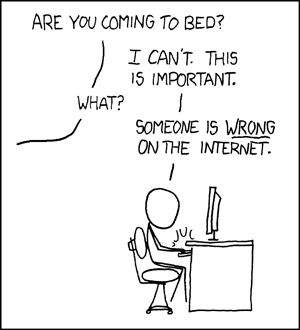
Addiction is bad. Addiction to stupid things is worse. And I have a confession: I am completely addicted to stupid internet fights that pop up in the comments of one of my favorite (for a value of, I read it a lot, and alternate between agreeing its dumb) blogs, Jezebel.com. While I generally don't comment-- I realize that stirring the arguments is kind of immature-- sometimes, I feel a little too much in common with a certain XKCD comic.
I don't know how on earth it is that something so seemingly small and insignificant can piss me off so much. It isn't jsut blatant stupidity-- those ones usually just make me roll my eyes and move on. Its something in the tone-- people that sound like they're on the attack, or sound self-righteous, or hypocritical. Or people who revel in ignorance while mocking things I care about, like science, or the law. Mocking science, especially, is a big problem on Jezebel. Part of it I can blame on the articles the editors choose to report on, and the way in which they do report. The articles are chosen to relate to women, with a slightly slightly feminist slant-- so something saying men prefer thin, young women might be posted with mocking dialouge, and then the commenters fall into a sea of "no-shit studies", "Can I have funding to talk about X observation", "why don't they cure cancer", and personal anecdotes aimed at trying to undercut the validity of the post.
A lot of commentors are pissed off because science, in those cases, is reinforcing beauty standards. Others are pissed off because it seems obvious-- but there are plenty of studies that find something "obvious" when the exact opposite result would also have been percieved as obvious. And a lot are pissed off because they percieve it as somehow being a personal insult or an affront to them-- especially when the articles address health and weight.
And I can. not. resist.
I refresh, and read all the comments, and feel my anger coming up-- over things people I have never even met, people I do not care about are saying. I get frustrated that, in a community that likes to think it is more educated and progressive than general, people are still proud to display their ignorance. I respond, sometimes, when something is particularly obnoxious, or when I think I have a great answer, or when its just a topic I know a fair bit amount. And it is so silly, and ridiculous, and a waste of time-- I read the site for the exposure to articles from more corners of the internet. And I end up in petty fights.
I didn't make any new years resolutions, and I didn't give up anything for lent, but I think its time for a little spring cleaning in my internet habits-- or at least, pausing to really think whether or not my comment is likely to change any minds, make anyone thing, or just stir up the clash further.
Virtual Reality
Child porn is bad. This is obvious.
Porn involving consenting adult individuals is a 1st amendment right-- for the adults viewing it, the adults selling it, and possibly even the adults making it. And it's something many people are very enthusiastic about loving.
So... what happens when the porn involves consenting adults who either look, or have been digitally altered to look, much younger than the age of consent? A stickier situation-- if only because its an ickier situation.
Right now, I'm researching some issues involving the 1st amendment. One of the cases I ran across is Ashcroft v. The Free Speech Coalition, 535 US 234. The case involves a statute that bans depictions of minors engaged in sexual situations-- even if no actual minors are involved in the making.
A gut, visceral reaction might be that this is not ok, and that people who want to wank to images that appear to be of teens or kids shouldn't get to. The Supreme Court disagrees. They talk about the fact that this statute would also inhibit artistic depictions, like Romeo and Juliet, or American Beauty, or Traffic... or Gossip Girl. But limiting the discussion to classy movies/plays takes the easy way out-- and ignores the ick factor of porn involving people who look like minors.
The idea of youth as beauty and as the sexual peak is pervasive in modern society. That's a given, I'd say. People counted down to the 18th birthdays of the Olsen twins and Emma Watson; adults get "crushes" on the characters of Gossip Girl and whatever else is on TV these days. So... it's almost a given that at least some people are seeing in their heads women or men who play the roles of teens on TV shows, if not actual teens. So, if we as a society are ok with deceptions of teenage sexuality in our entertainment... and if watching/making virtual teen sex with adult actors or computer modelling is a first amendment right... then is virtual minor porn... good? bad? indifferent?
Child porn-- or teen porn-- is bad because it involves a lack of consent and, unless its homemade porn by a couple teens, sexual abuse. Even if teens say they consent, they legally can't--hence a lot of the lawsuits surrounding the Girls Gone Wild franchise. In America, at least, there's a general moral approbation against minors and sex. So, while watching virtual-minor porn is a legal right-- is it morally right? I'm not entirely sure, to be honest. But I'm also not sure that it's any worse than porn that shows adults as adults. I don't think that masturbation, or watching porn are bad things. Yes, I know porn can be exploitative, and that it can lead to negative attitudes towards women, a sense of entitlement, and confusion over what to really do in the bedroom. But the people that are really effected that way are going to get similar messages from the rest of society, even without the overt sexuality. And watching porn is done by... I'm sure more than half the population. Hell, I'm sure more than half the female population watches porn-- though as least from anecdotal evidence (which yes, means approximately nothing) they tend to like different kinds.
And people like all kinds of porn! I don't have a problem with people who want to watch S/M porn, or doctor/patient, or porn where the characters seem to have questionable consent, or tentacle porn, or... well, you get the point. Other people's kinks don't bother me-- especially when they stay in the realm of fantasy. So what's the harm with someone who wants to jack off to it? Yeah, the thought is on the gross side. But so are a lot of things-- to a lot of people. And maybe your imagination would be on the sick side to someone else. You never know.
Thursday, May 26, 2011
In response to Danny's Corner: Are We Really That Rare?, OR, A Post On Adult Male Virginity
Apparently virgins count for less than 3% of the over-25-years-old male population of the US. While I sometimes think about virginity and the ways it's valued and constructed in US culture, I don't typically spend a lot of time thinking about adult virgins... unless I see posts like this one over at Danny's corner that actually address the issue.
I tend to assume that most people over the age of 25 have had sex at least once. I assume that there's a larger proportion of virgins in different, more religious subcultures than the one I'm in. And it seems that I'm mostly right. I do tend to assume that people-- male and female-- who are virgins into their mid twenties are religious... which might be because the one guy I know who I know for sure is a virgin is religious. He's of the courtship rather than dating mindset, so he's pretty extreme in his views as far as things go. But... it's a choice. And for another guy who I knew in college, it was also a choice. I have no clue what his status is now, since, well, college was four years ago, but for him it was that he wanted it to be special and all that jazz.
What I'm more curious about is how many guys are virgins into their mid twenties against their choices-- either because they're in relationships with men or women who are determined to not have sex, or because they are too busy to date and against one night stands, or because they just keep. striking. out. I know that there are definitely guys like this out there-- the whole "forever alone" concept, and sad self-posts to reddit are enough to make most people who spend too much time know that. A quick google also found me two websites focusing on involuntary celibacy, which is apparently also called Incel, though they include people who have had sex in the past, but who are long term celibate anyway. But I'm curious about the guys who are still virgins, and why, and if it's not by choice, why it is that they've been unable to find a sex partner. I'd guess shyness, mostly, because in the age of online dating, even if you are what the majority of society considers sexually unappealing, there are people who like all sorts of appearances, and a partner could probably be found online, even if it would take a lot of effort. For some, I'd think it might have to do with behavior-- I can't imagine a straight man who is openly hateful and misogynistic having much success with women, for example, or someone who is so shy he doesn't actually talk to women or make clear his interest. And for some, of course, I'd assume it's because they dated a woman who didn't want to lose her virginity for a long time, and after the relationship ended, have been unsure how to proceed.
I've noticed online that there's an idea that male virginity is a huge turn-off to women, and something most women would run from. I actually have no clue how most of my friends feel about this, for a change, because it's just something that has not come up-- other issues get talked about, but i think meeting male virgins doesn't even cross the mind of most of my dating lady-friends. Hell, the last virgin I encountered was in college, and he was 21. Most guys-- 97% of them, once they hit 25-- have had some experience. But 3% is still a really large number, when you think about. Just look at your Facebook-- you probably have, like, 500 Facebook friends. 3% of that number is 15. Now think about all the dudes in the US who are over the age of 25. Statistically, its a small number, but it's also a HUGE number, so a ton of guys out there aren't having sex, either by choice or without choice. And think how many more guys have had sex with one person who they aren't sexing anymore and who aren't having sex now. An even huger number! As someone who thinks that sex is an important, healthy part of being an adult (unless you're asexual) this is just... boggling and disturbing and saddening. Though I hope most virginal guys aren't sad, I have to think a large portion of them probably are, especially because of the messages society says about guys who "can't get laid" being worth less than other men. It's the sort of thing that also makes me annoyed that we don't have safe, legal prostitution or sex surrogates in this country (and my thoughts on sex work are enough to fill up many other posts, but in short: I think prostitution should be legal, I don't think it's any worse for most people than sleeping around with non prostitutes, but I think the ways it often happens in the US are not good situations for sex workers. Legalize and regulate is my motto in this as in many other things). It can't help erase frustration at not having a relationship, and it's unlikely to help a lot of guys with any underlying issues that may be keeping them celibate by choice, but it's at least something.
Friday, April 22, 2011
I think conversations about the variability of what people like in bed are fascinating. I don't say much about my own sexuality here (other than the obvious, that I'm married to a dude!), but one thing I will say is that I don't watch porn. I get why others do, but it just has never interested me. So, for an outsider's view, reading about what people are actually looking for and at is super interesting. And a study just came out talking about porn and search terms. I know this study is poorly researched and not at all valid ( which has been discussed in some of the science blogs I read, though i can't remember which ones, or I'd go read them now! And if I knew at the time it was about sexuality research, I would have paid more attention to those posts! But since it came in the midst of a sea of posts on climate, I just ignored, sadly, but at least i recognized the researchers names), but I think it's still worth thinking about, because of the basic assumptions of what porn is, and who views it, and the fact that even if they have their numbers wrong, the searches themselves do exist.
See, in general, it seems as if porn is angled as something men view to see women. Obviously there is porn made for women, and porn made for gay men, but the idea of porn directed at straight men that depicts women as sex objects to be used/consumed is the predominant one, both among anti-porn groups, and in casual discussions about porn online and off, even with people who use porn regularly. But i know plenty of ladies who enjoy porn, too, and some guys who don't. One of my best friends from college discovered porn when she was about 14, and proceeded to lock herself up every day after school and watch it for hour. A guy I knew in college said that he never watched porn because it was never as creative or specific as his imagination could be. Granted, I'm not saying either of them is representative of their genders, but just that the scope of how people interact with porn is likely broader than most of us initially picture.
I haven't read the full study, just the highlights on Jezebel (which, as I always mention, is a site that I strongly feel has gone downhill and which I would not call feminist, but which I still read because hell, it may be little more than a news aggregator these days, but it's an aggregator of things that interest me, at least). Two of the things they highlight are that there are a surprisingly large umber of searches for older women and fat/chubby women. Though this is likely in part due to the fact that a non specific porn search will turn up a lot of young, thing woman, it IS worth noting, because we as a society so often desexualize heavier and older women-- but there are plenty of people out there for whom that's right up their alley.
And yes, there are conversations to be had about whether being reduced to a sex object is actually progress, but I still think acknowledgement that different people like different things is important.
It emphasizes how much personal preferences play into who we find attractive-- something that really first hit me in college when I realized that my closest girl friends and i did not really have overlapping taste in men. And when I realized most people find Brad Pitt hot. Personally, I think he has a nice body, but looks like a monkey. But anyway-- variety abounds! And preferences for different parts of that variety abound too! So much of culture and, from what I understand, mainstream porn tells us that there is something that is universally desirable, and that all people would go for that if given the chance-- but the porn searches (and conversations in which people just can not figure out where their friends are coming from) show that that isn't really the case.
See, in general, it seems as if porn is angled as something men view to see women. Obviously there is porn made for women, and porn made for gay men, but the idea of porn directed at straight men that depicts women as sex objects to be used/consumed is the predominant one, both among anti-porn groups, and in casual discussions about porn online and off, even with people who use porn regularly. But i know plenty of ladies who enjoy porn, too, and some guys who don't. One of my best friends from college discovered porn when she was about 14, and proceeded to lock herself up every day after school and watch it for hour. A guy I knew in college said that he never watched porn because it was never as creative or specific as his imagination could be. Granted, I'm not saying either of them is representative of their genders, but just that the scope of how people interact with porn is likely broader than most of us initially picture.
I haven't read the full study, just the highlights on Jezebel (which, as I always mention, is a site that I strongly feel has gone downhill and which I would not call feminist, but which I still read because hell, it may be little more than a news aggregator these days, but it's an aggregator of things that interest me, at least). Two of the things they highlight are that there are a surprisingly large umber of searches for older women and fat/chubby women. Though this is likely in part due to the fact that a non specific porn search will turn up a lot of young, thing woman, it IS worth noting, because we as a society so often desexualize heavier and older women-- but there are plenty of people out there for whom that's right up their alley.
And yes, there are conversations to be had about whether being reduced to a sex object is actually progress, but I still think acknowledgement that different people like different things is important.
It emphasizes how much personal preferences play into who we find attractive-- something that really first hit me in college when I realized that my closest girl friends and i did not really have overlapping taste in men. And when I realized most people find Brad Pitt hot. Personally, I think he has a nice body, but looks like a monkey. But anyway-- variety abounds! And preferences for different parts of that variety abound too! So much of culture and, from what I understand, mainstream porn tells us that there is something that is universally desirable, and that all people would go for that if given the chance-- but the porn searches (and conversations in which people just can not figure out where their friends are coming from) show that that isn't really the case.
Tuesday, January 18, 2011
How should a crime that kills a wanted fetus be classified?
I recently (possibly today? Possibly a few days ago? Everything runs together when you realize you have to finish planning a wedding and fill out a Bar application in less than two months!) read an article on Jezebel-- and then the initial news article-- on laws affecting crimes against pregnant women, specifically ones that cause them to miscarry.
I tried to refind the articles, but I can't. Which annoys me, because context is always helpful. But at any rate, the issue is how do you deal with an attack that causes a miscarriage? Is it simply ignored, with the crime against the woman considered, whether it's murder or just assault? Is it an additional homicide in cases where the parent(s) were intending to bring it to term? Is it an unlawful abortion? Is it a form of theft?
The way it's dealt with matters, because in both the law and society, words have meaning-- and application of laws can create precedent. We dealt with this situation some back in 1L Criminal law. I don't remember how most of the people in the class felt, but I do remember that the cases dealt with scenarios where the woman wanted a child, and some of them were pretty horrifying, in part because of our societal views that pregnant women are to be protected, and in part just because of the brutality of the attack (I still remember reading about one man who said he was going to "stomp the baby" out of a woman).
I do think it should be taken seriously-- and I don't think that that in any way is in conflict with my being pro-choice. It's pro-choice. Which means I respect the choices that women make for their bodies and reproductive futures, and I don't think abortions or miscarriages should be forced any more than I think they should be prohibited. But the killing of a wanted fetus that the mother is planning to bring to term still should not count as a homicide-- because a fetus is not a person. When it dies, a person is not dying-- a potential person is, even though a couple who wants a child may have already named it, and may already be emotionally thinking of it as a person. But it isn't a person.
Still, because of their hopes and dream and effort put into it, and lifestyle changes, and potential dangers of just being pregnant, people invest a lot into a wanted pregnancy. And there should be some kind of extra charge. I guess the best that I can come up with would be a new charge, based on the idea of theft, but even that doesn't quite convey the right tone. It's a trespass against someone's body in a way that a normal physical assault isn't, and it steals their past efforts and their hope of having that fetus be a child. So I don't think it should be ignored, and I don't think it should be treated as murder, but I do think there should be some additional charge, and I also think that that is completely in low with a pro-choice viewpoint.
Saturday, January 8, 2011
So, a pick up artist has allegedly shot a woman in the face
So, a man called Gunwitch, who is internet famous for running a pick-up artist site has allegedly shot a woman in the face.* My first reaction to reading about this was to be… horrified, but not extremely surprised. Which is so, so cynical—but if you ever stop by pick-up or “game” blogs, you quickly realize that most of the guys who are well known in those circles project seriously hateful, dismissive, and entitled attitudes towards women, and that a lot of the attitude that gets spoken about is a mindset where women’s only worth is found in their fuckability—women are discussed as objects to gain access to, whose feelings, desires, and humanity are nothing compared to a guy’s desire to get laid. It’s disturbing.
I have to think that most guys who read those sites are probably not that messed up though, because otherwise, it’s just sad. A lot of the men who read pick-up sites are probably just insecure and bad with women—and if all the sites taught men was how to be their best selves, I wouldn’t have a problem with them. But they don’t, and the men who spend a lot of time on those sites come off as terrible human beings. Their tactics seem aimed at focusing on women with low self esteem or reducing a woman’s self esteem, on lying about themself, on projecting threat, and on physically getting her away from her friends. Gunwitch’s pickup strategies seem to be focused on threat—escalating physical contact, projecting animal sexuality (which—what does that even mean? It seems to mean, treat her like an object you own), and ignoring any body cues or language that a normal human being would interpret to mean stop. His catchphrase seems to be “make the ho say no”—an idea that a man shouldn’t leave a woman alone until she flat out directly refuses him. In American culture, at least, women are taught from the time we’re girls that we’re supposed to be “nice”, that we shouldn’t flatly turn guys down because it will hurt their fragile egos, and that we need to sort of finagle are way out of being hit on. Problem is, if you’re stuck in a corner while some guy keeps putting his hands on you, and you’re trying to get out while saying “I really don’t think this is a good idea” or trying to put him off with a phone number so that you can politely ignore him later without the direct esteem blow—well, this guy’s advice is for men to ignore all that and just touch her more. Until she either actually says not, or just stops trying to escape.
I can totally see a woman stopping her escape attempts in this situation, not because she’s been seduced, but because the man is acting so outside of the normal bounds of human behavior that she’s afraid he’ll become violent if she doesn’t just shut up. And sure, that might not lead to sex, but it’s going to lead to her dealing with a lot more touching than her comfort zone is ok with. Plus, we all know that not all guys interpret no to mean no—I remember running around a club one night in college, trying to avoid a man who kept groping me, even after I’d told him thatn o, I did not want him touching me and no, I had no interest in him whatsoever.
So with all that—I find Gunwitch’s methods to be horribly creepy and morally deficient. But the phrase “make the ho say no” has another problem—ho.
It seems that a lot of men in the pick-up (and men’s rights) community view all women as—or at least, all American women—as morally devoid sluts… who still need to be seduced to get them into bed. (There is a blog post somewhere on the ridiculousness of this doublebind. I thought it was on Figleaf’s blog, but can’t find it. You should check out his blog anyway.)
I know, the two concepts don’t make much sense together. The amount of cognitive dissonance going on in some people’s heads must be staggering. And it will seem really odd if, like me, the men you know in real life are all good human beings who treat women like people and yet who still manage to have self respect and earn the respect of others. But the truth remains—there are women who go out to bars or other locations, who live relatively chaste lives, and who are not going to go home with some random PUA no matter what his “game” is like. There are also women who go out to bars looking for someone to go home with—and who might go home with a PUA, not because he has good “game”, but because he happened to be there and interested, and not too bad looking at the right time. Pick-up treats women as if we’re all the same creature though, and as if we’re all able to be manipulated in the same easy X number of steps.
But a lot of guys will admit that pick-up is really just mostly a numbers game. Which means that the pick up itself, for most people, is probably not what’s getting them laid—the fact that they asked ten women, and found one of two or three in the bar who was already looking to get laid is. (Sidenote: I think it’s interesting how many guys in pickup talk about the “number close”, where they get a woman’s phone number. When I was single, giving the phone number was usually a good way to get a guy to leave me alone when he wouldn’t listen to me telling him I wasn’t interested. Then when you get a chance, change his name in your phone to “Do Not Answer”. You’ve already told him you aren’t interested, and since he’s begged for your phone number “in case you change your mind”, he’ll be able to tell that you…. Haven’t changed your mind)
So yes, I’m horrified, and honestly surprised that a pick-up artist actually (allegedly) shot a woman, even though my first instinct was to not be surprised. But in a way, it makes a sick kind of sense—if you’re part of a culture that views women as only good for sex, and you are in fact someone who teaches others how to dehumanize women, then it makes sense that eventually you might internalize it to the extant that you end up shooting a woman. I don’t know that the shooting was intentional, of course—other’s have pointed out that in his most recent videos, Gunwitch seemed mentally unstable, and managed to shoot a bullet into his wall with a gun he thought was unloaded. Even if he was just trying to be cool and do an idiotic form of show and tell, he’s still responsible for shooting her in the face. I’m just saying that, at this point, shooting a woman in the face is a disturbing, but slightly logical, extension of some of the thought in pickup blogs that treats women as interchangeable and less than human.
*Because I’m not a court of law, or even a lawyer, I’m going to say that I think he’s very likely to be guilty. Because, contrary to some people’s understandings, innocent until proven guilty doesn’t mean that individuals can’t have their own opinion as to someone’s guilt or innocence. So no, I don’t know that he shot her in the face. But I think, given what’s been reported, that he probably did.
Tuesday, August 10, 2010
Angry Feminist Rant. Probably Slightly Incoherent.
Questions people often ask feminists online:
Why would you choose to align yourself with a group with such negative connotations?
If you really believe in equality, shouldn't you call yourself an equalist or a humanist, not a feminist?
You know what? As novel as my understanding of feminism may seem to some people, I didn't blindly come up with it and pull it from whole cloth. Nope. I'm a creative person, but I'm not THAT creative. Instead, I looked around at the prevailing use and definition of the word feminism in feminist circles. Because really, who are you going to believe-- haters or people who have never bothered to read up on the topic, or people that are immersed in the topic, and have an understanding of the topic, and are part of the community? It's like when non-Christians try to tell me I'm not Christian because I don't go to church every Sunday, or believe every tenant of whatever Christian denomination they're most familiar with.
And like Christianity-- or any religion, or any political movement, or any other thing someone can self-identify as, there's a lot of wiggle room inside one broad definition. There are some crazy feminists out there! I don't know any feminist who denies that! But there are crazies in Every. Single. Movement. Modern feminism-- the feminism of women in my age group, the feminism of third wavers, the feminism that is what most people on the internets are talking about when they talk about feminism-- it bears very little relation to radical feminism or the feminism of Andrea Dworkin and Catherine MacKinnon. Sure, there are still radical feminists out there! And there are enough of them that if all you want to find are radfem blogs, you could probably do that! But that is not what the MAJORITY of the modern feminist movement is. It's incredibly stupid to disavow an entire movement because of radicals who share the label. You don't throw the movement away-- you get active IN it, and do something! Granted, most of what I do is just blogging and talking to friends and leaving comments on the blogs of people who drastically disagree with me, but I want to do more, and I want to hold on to feminism, because I believe in it. I believe that women are every bit as valuable and capable and worth respect as men are. I believe that who you are should matter more than the genitalia you bear.
As to the name? Well, the movement is about equality, yes, but with a focus on women, and on advancing women to be equal with men-- as well as on changing some things that do go beyond pure equality. The equality feminism wants isn't to make men's situations worse to match women, but to make women's better to match men. But it's true-- while equality is the core, much modern feminism goes beyond that, and looks to ways to better life all around. Extending paternity and maternity leave, for example, are feminist goals-- yet this goal isn't just pushing for equality, but to expand the status quo into a better situation for both genders.
I think it's kind of awesome, actually, that feminism wants to make things better for everyone, and I have no shame in belonging to a group that prioritizes women. Every group must have some kind of focus, or nothing will get accomplished. Feminism is ultimately, fundamentally about women's rights. By the definition of feminism, things that fight for women's rights are feminist, even if they also fight for other things! And you know what? Something having equality at it's core doesn't preclude it from saying "Hey! Situation X is bad ALL AROUND, let's fix it!" or "Situation Y affects women only, but let's fix it!". (What, you might be wondering could possibly affect only women*? How about breastfeeding. Or menstruation. Or policies surrounding childbirth. Parenting sure as hell is a men's issue as well as a women's issue, but the choice between a diva cup or tampon or pad and dealing with it when you get one break every X number of hours but have a very heavy flow is an issue most men don't face.
Feminism is still needed. We've come a long, long way from when my mother first started teaching and was required to wear skirts, and a longer way from when my grandmother was a girl. Married women and women with children are allowed to hold down jobs. The wage gap has gotten a lot smaller and isn't as simple as a company literally setting different pay scales for men and women. It's illegal for a man to rape his wife. But really. We've still got a long, long, long way to go. And I think feminism is necessary to get us there.
Quite simply-- I'm proud that I'm a feminist.
* (ok, this is being very cis-centric, and I realize these issues may also affect transmen, but please stay with me.)
Why would you choose to align yourself with a group with such negative connotations?
If you really believe in equality, shouldn't you call yourself an equalist or a humanist, not a feminist?
You know what? As novel as my understanding of feminism may seem to some people, I didn't blindly come up with it and pull it from whole cloth. Nope. I'm a creative person, but I'm not THAT creative. Instead, I looked around at the prevailing use and definition of the word feminism in feminist circles. Because really, who are you going to believe-- haters or people who have never bothered to read up on the topic, or people that are immersed in the topic, and have an understanding of the topic, and are part of the community? It's like when non-Christians try to tell me I'm not Christian because I don't go to church every Sunday, or believe every tenant of whatever Christian denomination they're most familiar with.
And like Christianity-- or any religion, or any political movement, or any other thing someone can self-identify as, there's a lot of wiggle room inside one broad definition. There are some crazy feminists out there! I don't know any feminist who denies that! But there are crazies in Every. Single. Movement. Modern feminism-- the feminism of women in my age group, the feminism of third wavers, the feminism that is what most people on the internets are talking about when they talk about feminism-- it bears very little relation to radical feminism or the feminism of Andrea Dworkin and Catherine MacKinnon. Sure, there are still radical feminists out there! And there are enough of them that if all you want to find are radfem blogs, you could probably do that! But that is not what the MAJORITY of the modern feminist movement is. It's incredibly stupid to disavow an entire movement because of radicals who share the label. You don't throw the movement away-- you get active IN it, and do something! Granted, most of what I do is just blogging and talking to friends and leaving comments on the blogs of people who drastically disagree with me, but I want to do more, and I want to hold on to feminism, because I believe in it. I believe that women are every bit as valuable and capable and worth respect as men are. I believe that who you are should matter more than the genitalia you bear.
As to the name? Well, the movement is about equality, yes, but with a focus on women, and on advancing women to be equal with men-- as well as on changing some things that do go beyond pure equality. The equality feminism wants isn't to make men's situations worse to match women, but to make women's better to match men. But it's true-- while equality is the core, much modern feminism goes beyond that, and looks to ways to better life all around. Extending paternity and maternity leave, for example, are feminist goals-- yet this goal isn't just pushing for equality, but to expand the status quo into a better situation for both genders.
I think it's kind of awesome, actually, that feminism wants to make things better for everyone, and I have no shame in belonging to a group that prioritizes women. Every group must have some kind of focus, or nothing will get accomplished. Feminism is ultimately, fundamentally about women's rights. By the definition of feminism, things that fight for women's rights are feminist, even if they also fight for other things! And you know what? Something having equality at it's core doesn't preclude it from saying "Hey! Situation X is bad ALL AROUND, let's fix it!" or "Situation Y affects women only, but let's fix it!". (What, you might be wondering could possibly affect only women*? How about breastfeeding. Or menstruation. Or policies surrounding childbirth. Parenting sure as hell is a men's issue as well as a women's issue, but the choice between a diva cup or tampon or pad and dealing with it when you get one break every X number of hours but have a very heavy flow is an issue most men don't face.
Feminism is still needed. We've come a long, long way from when my mother first started teaching and was required to wear skirts, and a longer way from when my grandmother was a girl. Married women and women with children are allowed to hold down jobs. The wage gap has gotten a lot smaller and isn't as simple as a company literally setting different pay scales for men and women. It's illegal for a man to rape his wife. But really. We've still got a long, long, long way to go. And I think feminism is necessary to get us there.
Quite simply-- I'm proud that I'm a feminist.
* (ok, this is being very cis-centric, and I realize these issues may also affect transmen, but please stay with me.)
Monday, May 10, 2010
Skirt Challenge!
So. There you go. Six more days of me wearing skirts. I did it! I wore skirts or dresses for a total of seven days straight! I couldn't manage to gt blogger to put them in the proper order, but you can get an idea of the shifts in weather by the shifts in clothing-- from stifling heat the day I wore the mini skirt, to fifty degree weather the days I wore the sweaters. I do like wearing skirts and dresses. I used to wear them more often than pants, but jeans are more durable, and I somehow have just ended up with less skirts, and less shirts that go with my skirts. Wearing skirts doesn't really impact my day to day life-- I spend most of my time sitting down, studying. It does make me automatically feel more "put together", though I do think that some outfits with jeans are more flattering than some of my outfits with skirts. It also sort of helps trick me into studying more when I'm in the more "professional" looking clothing. Skirts definately aren't appropriate for everything though-- hiking or the gym? I'd get all tangled up, and be uncomfortable. But for everyday life, well... I'm going to make a conscious effort to wear them more often. I might wait until it gets warmer again though, because right now? it is COLD and I hate stockings. They just aren't comfortable, and comfort is a high priority to me during exams.
Amusingly, the days it was warm it seemed like nearly everyone else was wearing skirts too. But it's been a ridiculously cold spring. I'm also likely to keep taking pictures of my outfits, and posting them at my flickr account. So.... outfits behind the jump!
Amusingly, the days it was warm it seemed like nearly everyone else was wearing skirts too. But it's been a ridiculously cold spring. I'm also likely to keep taking pictures of my outfits, and posting them at my flickr account. So.... outfits behind the jump!
Monday, April 26, 2010
In which Jenny and I talk about Boobquake and breast cancer, because I have Too Much Work to write an independent post.
(4/26/2010 11:44:26 AM) Jenny: it is SO COLD in the library
(11:44:47 AM) Amanda: mine is pretty cold too
(11:44:53 AM) Amanda: yet another reason not to do boobquake!
(11:45:06 AM) Jenny: boobquake is stupid.
(11:45:14 AM) Amanda: it is enough that people can probably see my nipples even in this sweater
(11:45:16 AM) Amanda: I agree
(11:45:19 AM) Amanda: I think it's a terrible idea
(11:45:29 AM) Amanda: I have been debating in my head whether or not it's unfeminist
(11:45:35 AM) Amanda: bc on the one hand: agency! choice!
(11:45:43 AM) Jenny: it's along the lines of the "save the tatas" shirts for breast cancer
(11:45:51 AM) Amanda: and on the other... lets all flash as much tits as we can!
(11:45:52 AM) Amanda: right
(11:45:55 AM) Jenny: using the power of breasts for good
(11:46:01 AM) Amanda: I kind of like the spirit, but I hate everything else
(11:46:02 AM) Jenny: still means you're nothing without those tits.
(11:46:11 AM) Amanda: it's like, you get an e for effort.... but an f for fail
(11:46:15 AM) Jenny: yeah
(11:46:28 AM) Jenny: here's a thought: you could just talk about why cleavage doesn't cause earthquakes.
(11:46:45 AM) Amanda: indeed
(11:46:51 AM) Jenny: or about how breast cancer kills men and women, it doesn't just take breasts
(11:46:58 AM) Amanda: also very true!
(11:47:11 AM) Amanda: and hey, I’m kind of sick of the fact that breast cancer gets so much attention
(11:47:15 AM) Jenny: OH MY GOD ME TOO
(11:47:15 AM) Amanda: I mean, yes, its awful
(11:47:23 AM) Jenny: not to mention that MOST breast cancer is incredibly treatable.
(11:47:27 AM) Amanda: but lets talk about the things that most people don't recover from!
(11:47:30 AM) Amanda: exactly!
(11:47:32 AM) Jenny: that means you're not going to die from it. SHUT UP.
(11:47:40 AM) Jenny: let's talk about pancreatic cancer.
(11:47:43 AM) Jenny: or liver cancer.
(11:47:51 AM) Jenny: or glioblastoma multiforme
(11:47:53 AM) Amanda: those are the first two I was thinking of, actually
(11:47:58 AM) Amanda: ok, that last one I don't know about
(11:48:01 AM) Jenny: oh god
(11:48:02 AM) Amanda: and that? is the problem
(11:48:07 AM) Amanda: why DON'T I know about it?
(11:48:11 AM) Jenny: don't read about it if you don't want to get terribly depressed
(11:48:15 AM) Amanda: noted!
(11:48:20 AM) Jenny: you should know about it.
(11:48:24 AM) Jenny: everyone should.
(11:48:36 AM) Jenny: because the symptoms are remarkably similar to depression and Alzheimer's
(11:48:56 AM) Jenny: depending on where the tumor is in the brain, you can get personality changes, depression, rapid mood swings, etc
(11:49:13 AM) Amanda: Also things we need to talk more about! Especially Alzheimer's, because there's so much research there, I feel like if they had better funding, then prevention might be close
(11:49:29 AM) Jenny: heh
(11:49:42 AM) Jenny: I'd take a working treatment, honestly
(11:49:48 AM) Amanda: well, that too
(11:49:51 AM) Amanda: that would be awesome
(11:50:08 AM) Jenny: there are so many things that are tons and tons more debilitating than breast cancer
(11:50:26 AM) Jenny: even non-cancers, like MS, diabetes, atherosclerosis
(11:50:34 AM) Jenny: things that can really affect your quality of life
(11:50:40 AM) Jenny: things that sometimes ARE preventable
(11:51:06 AM) Amanda: YES
(11:51:27 AM) Jenny: or cancers that are deadly but preventable, like melanoma
(11:51:45 AM) Jenny: breast and prostate cancer are small potatoes compared to some
(11:51:53 AM) Amanda: yup
(11:52:03 AM) Amanda: although I DO think it's great you're working on prostate cancer
(11:52:15 AM) Amanda: because that work needs done too
(11:52:21 AM) Amanda: it's just the media that bothers me
(11:52:30 AM) Amanda: if we can't make cancer "sexy", we don't care
(11:52:35 AM) Jenny: prostate cancer gets into serious quality of life issues
(11:52:48 AM) Jenny: yeah, you know what's not sexy? progressive loss of motor control.
(11:53:16 AM) Jenny: ugh
(11:53:24 AM) Jenny: GBM is so depressing it makes me literally nauseated
(11:53:35 AM) Amanda: <3
(11:44:47 AM) Amanda: mine is pretty cold too
(11:44:53 AM) Amanda: yet another reason not to do boobquake!
(11:45:06 AM) Jenny: boobquake is stupid.
(11:45:14 AM) Amanda: it is enough that people can probably see my nipples even in this sweater
(11:45:16 AM) Amanda: I agree
(11:45:19 AM) Amanda: I think it's a terrible idea
(11:45:29 AM) Amanda: I have been debating in my head whether or not it's unfeminist
(11:45:35 AM) Amanda: bc on the one hand: agency! choice!
(11:45:43 AM) Jenny: it's along the lines of the "save the tatas" shirts for breast cancer
(11:45:51 AM) Amanda: and on the other... lets all flash as much tits as we can!
(11:45:52 AM) Amanda: right
(11:45:55 AM) Jenny: using the power of breasts for good
(11:46:01 AM) Amanda: I kind of like the spirit, but I hate everything else
(11:46:02 AM) Jenny: still means you're nothing without those tits.
(11:46:11 AM) Amanda: it's like, you get an e for effort.... but an f for fail
(11:46:15 AM) Jenny: yeah
(11:46:28 AM) Jenny: here's a thought: you could just talk about why cleavage doesn't cause earthquakes.
(11:46:45 AM) Amanda: indeed
(11:46:51 AM) Jenny: or about how breast cancer kills men and women, it doesn't just take breasts
(11:46:58 AM) Amanda: also very true!
(11:47:11 AM) Amanda: and hey, I’m kind of sick of the fact that breast cancer gets so much attention
(11:47:15 AM) Jenny: OH MY GOD ME TOO
(11:47:15 AM) Amanda: I mean, yes, its awful
(11:47:23 AM) Jenny: not to mention that MOST breast cancer is incredibly treatable.
(11:47:27 AM) Amanda: but lets talk about the things that most people don't recover from!
(11:47:30 AM) Amanda: exactly!
(11:47:32 AM) Jenny: that means you're not going to die from it. SHUT UP.
(11:47:40 AM) Jenny: let's talk about pancreatic cancer.
(11:47:43 AM) Jenny: or liver cancer.
(11:47:51 AM) Jenny: or glioblastoma multiforme
(11:47:53 AM) Amanda: those are the first two I was thinking of, actually
(11:47:58 AM) Amanda: ok, that last one I don't know about
(11:48:01 AM) Jenny: oh god
(11:48:02 AM) Amanda: and that? is the problem
(11:48:07 AM) Amanda: why DON'T I know about it?
(11:48:11 AM) Jenny: don't read about it if you don't want to get terribly depressed
(11:48:15 AM) Amanda: noted!
(11:48:20 AM) Jenny: you should know about it.
(11:48:24 AM) Jenny: everyone should.
(11:48:36 AM) Jenny: because the symptoms are remarkably similar to depression and Alzheimer's
(11:48:56 AM) Jenny: depending on where the tumor is in the brain, you can get personality changes, depression, rapid mood swings, etc
(11:49:13 AM) Amanda: Also things we need to talk more about! Especially Alzheimer's, because there's so much research there, I feel like if they had better funding, then prevention might be close
(11:49:29 AM) Jenny: heh
(11:49:42 AM) Jenny: I'd take a working treatment, honestly
(11:49:48 AM) Amanda: well, that too
(11:49:51 AM) Amanda: that would be awesome
(11:50:08 AM) Jenny: there are so many things that are tons and tons more debilitating than breast cancer
(11:50:26 AM) Jenny: even non-cancers, like MS, diabetes, atherosclerosis
(11:50:34 AM) Jenny: things that can really affect your quality of life
(11:50:40 AM) Jenny: things that sometimes ARE preventable
(11:51:06 AM) Amanda: YES
(11:51:27 AM) Jenny: or cancers that are deadly but preventable, like melanoma
(11:51:45 AM) Jenny: breast and prostate cancer are small potatoes compared to some
(11:51:53 AM) Amanda: yup
(11:52:03 AM) Amanda: although I DO think it's great you're working on prostate cancer
(11:52:15 AM) Amanda: because that work needs done too
(11:52:21 AM) Amanda: it's just the media that bothers me
(11:52:30 AM) Amanda: if we can't make cancer "sexy", we don't care
(11:52:35 AM) Jenny: prostate cancer gets into serious quality of life issues
(11:52:48 AM) Jenny: yeah, you know what's not sexy? progressive loss of motor control.
(11:53:16 AM) Jenny: ugh
(11:53:24 AM) Jenny: GBM is so depressing it makes me literally nauseated
(11:53:35 AM) Amanda: <3
And that's that, because you really don't want the additional conversation about her lab and the random people who show up in my section of the library during finals.
Sunday, March 21, 2010
Why I blog
So, this is my 100th post! Yay! And in honor of it being my 100th post... I want to talk about why I blog.
First, I need an outlet for all my crazy besides JD. He's long-suffering and awesome, but writing things down and making them concrete has a different kind of satisfaction to it. I've always found that speaking and writing really help me to solidify my views-- being challenged, being forced to put it into words.
So why the internet? Why blog instead of just use a paper diary? Well, for one, I enjoy typing and the ability to view my words and do some editing. I do keep a paper journal, but that has details of my actual life-- I don't discuss friendships or my relationship here, as much as I get tempted to. I try to keep away from whining or being passive aggressive and stick to discussing ideas, news, trends-- things I notice in the world, or that friends point out to me, instead of things that are truly personal.
So, why feministy topics? Well, for one, I'm a woman. That means things that affect women end up being of particular importance to me. I'm also very interested in civil rights that don't affect me-- gay rights and prison reform being some of the big things that get my mind. I've also become more aware of the ways that society is biased against women. I have some wonderful parents who were extremely egalitarian growing up, so I didn't really have anything to chafe against there-- and when I was in school, well, I was an awkward nerd who hung out mostly with other girls, so I didn't really see a lot of sexist sentiments. And honestly, my friends and I were weird enough that dating topics weren't even some of our concerns. But in recent years, I've seen more and more sexism, both on the internet and in real life-- and while I do see some misandry, I see far, far more misogyny in real life, and I see it in such a casual context that it seems like people have internalized it.
So I want to get thinking more about feminist topics and the way society depicts gender roles-- even in TV, where men are often depicted as idiots and women as shrews. I have a huge problem with that sort of thing, and I'm totally willing to share that annoyance.
Plus, even though this blog is essentially aimed at friends, it gives me kind of a "whoa" shock when other people find my blog, and when I see a day where someone has linked to it and I get a ton of hits in a day. So I guess vanity comes into it a bit too.
But overall-- it's really just the enjoyment of writing and crystallizing thought and the idea of a huge worldwide conversation where someone from anywhere might see my blog-- and maybe even comment on it.
Subscribe to:
Posts (Atom)